Showing posts with label Amazing Facts. Show all posts

Tuesday, February 1, 2011

Icredible Pillar Island

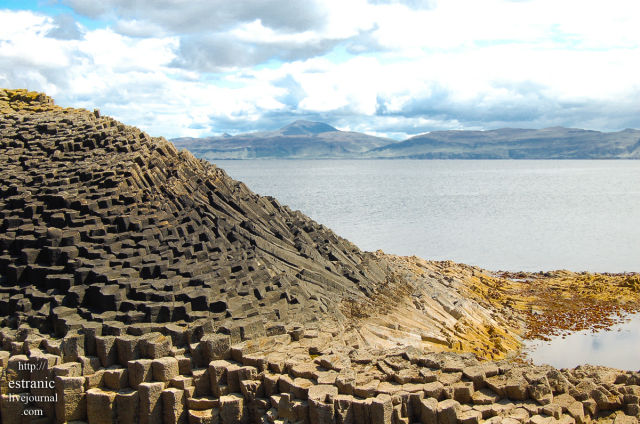
Staffa, a name for pillar island, is an island of the Inner Hebrides in Argyll and Bute, Scotland. The Vikings gave it this name as its columnar basalt reminded them of their houses, which were built from vertically placed tree-logs. The island is entirely of volcanic origin. It lies about 10 kilometres (6.2 mi) west of the Isle of Mull. The area is 33 hectares (0.13 sq mi).


Many famous personalities visited the island after it was discovered by Sir Joseph Banks in the 18 th century. He was fascinated by the natural beauty of the basalt columns and its main sea cavern, which Banks re-named 'Fingal's Cave'. Among the prominent people who visited the island were Queen Victoria and Felix Mendelssohn, who later brought further fame to the island by writing the island very beautiful and gave a name to its main sea cavern during the 18th and 19th centuries. The island came to prominence in the late 18th century after a visit by Hebrides Overture opus 26.


Only one family lived there in the 18th century, but deserted the island because of severere winter storms. The island has been uninhabited for 2 centuries now.

Staffa had several owners and eventually was gifted by an American owner Jock Elliot Jr. of New York in 1986 to the National Trust for Scotland.

The interesting faxct is that in 1800 there were three Red Deer on the island, later replaced by goats and then a small herd of black cattle. Subsequently the summer grazing was used for sheep by crofters from Iona but in 1997 all livestock was removed. This has led to a regeneration of the island's vegetation.


You can visit the island and view its caves and the puffins by boat from Oban, Dervaig on Mull, Fionnphort and Iona allow between May and September.

There is a landing place used by the tourist boats just north of Am Buachaille, but disembarkation is only possible in calm conditions. The island lacks a genuine anchorage.




Saturday, November 13, 2010

Abandoned on a tiny shadeless island for 15 years, eating seagulls


A corvette drops anchor near a small island, lost in the Indian Ocean, on November 29, 1776. The island seems completely deserted, a stretch of white sand with a few palm trees. Yet the sailors discover a baby and seven women, all former slaves from Madagascar. Dressed in tunics of woven feathers, they are the only survivors of a shipwreck 15 years earlier. They survived by eating birds, turtles and shellfish.


The 26 African immigrants that were picked up by a Spanish fishing trawler in the open Mediterranean earlier this week have been transferred to a Spanish rescue ship, the transport ministry said.


The immigrants were taken aboard the Clara Campoamor some 40 maritime miles off the Italian island of Sicily, it said in a statement. The ship will now take them to the northeastern Spanish port of Tarragona.


Conditions aboard the trawler Montfalco were difficult due to a lack of supplies and limited space but the 26 Africans who are believed to be from the Ivory Coast were in good health, it added.


Italy, Libya and Malta refused to allow the would-be immigrants to disembark arguing the Africans were in international waters when they were rescued by the Spanish trawler despite appeals from Madrid for them to do so.


Spanish Employment and Social Affairs Minister Jesus Caldera appealed to all nations in the European Union to respect laws regarding rescues in the open waters, which he said had not occurred in this case.


Tuesday, November 2, 2010

Bear's Crap

Sounds weird, but it's quite interesting.

Сowberry diet

Blueberry diet

Rowan diet

Pine nuts diet


Monday, October 25, 2010

One good polar bear story

Polar Bear: I come in Peace

Norbert Rosing's striking images of a wild polar bear coming upon tethered sled dogs in the

wilds of Canada's Hudson Bay.

The photographer was sure that he was going to see the end of his dogs when the polar bear wandered in.

It's hard to believe that this polar bear only needed to hug someone!

The Polar Bear returned every night that week to play with the dogs.

Thursday, October 21, 2010

Sand Cat Kittens Debut at Sweden’s Parken Zoo

The Parken Zoo in Sweden recently welcomed a new litter of Sand Cat kittens, and boy are they cute!

The Sand Cat is a relatively small, stocky cat with short legs, a long tail, and large pointed ears. They range from 15 to 22 inches in length, not including a foot-long tail. Among the smallest of the wild cats, the Sand Cat adult weighs between 3 and 7-1/2 lbs.

In the wild, Sand Cats live in dry, sandy desert areas. They prefer flat or undulating terrain with sparse vegetation, but avoid bare sand dunes where there is relatively little food. They can survive in temperatures ranging from 23 °F to 126 °F, surviving the brutal heat by retreating into burrows. They are able to survive for months on the water in their food.

Tuesday, September 28, 2010

Circus Freaks of the Past (25 pics)

Freak shows were very popular in the past. And an actor with a rare physical anomaly could make a circus owner rich. Here are the most famous circus freaks of the past.