Manchester United Football Club is an English professional football club, based in Old Trafford, Greater Manchester, that plays in the Premier League. Founded as Newton Heath LYR Football Club in 1878, the club changed its name to Manchester United in 1902 and moved to Old Trafford in 1910. In 1968, under the management of Matt Busby, Manchester United was the first English football club to win the European Cup, ten years after the Munich air disaster that claimed the lives of eight players. The current manager, Alex Ferguson, is the most successful manager in the club's history, having won 26 major honours since he took over in November 1986.


Manchester United was formed in 1878 as Newton Heath LYR Football Club by the Carriage and Wagon department of the Lancashire and Yorkshire Railway depot at Newton Heath. The team initially played games against other departments and rail companies, but on 20 November 1880, they competed in their first recorded match; wearing the colours of the railway company – green and gold – they were defeated 6–0 by Bolton Wanderers' reserve team. By 1888, the club had become a founding member of The Combination, a regional football league.

However, following the league's dissolution after just one season, Newton Heath joined the newly formed Football Alliance, which ran for three seasons before being merged with the Football League. This resulted in the club starting the 1892–93 season in the First Division, by which time it had become independent of the rail company and dropped the "LYR" from its name. After just two seasons, the club was relegated to the Second Division. In January 1902, with debts of £2,670 – equivalent to £210,000 as of 2011 – the club was served with a winding-up order. Captain Harry Stafford found four local businessmen, including John Henry Davies (who became club president), each willing to invest £500 in return for a direct interest in running the club and who subsequently changed the name; on 24 April 1902, Manchester United was officially born.

Under Ernest Mangnall, who assumed managerial duties in 1903, the team finished as Second Division runners-up in 1906 and secured promotion to the First Division, which they won in 1908 – the club's first league title. The following season began with victory in the first ever Charity Shield and ended with the club's first FA Cup title. Manchester United won the First Division for the second time in 1911, but at the end of the following season, Mangnall left the club to join Manchester City. In 1922, three years after the resumption of football following the First World War, the club was relegated to the Second Division, where it remained until regaining promotion in 1925.
 Relegated again in 1931, Manchester United became a yo-yo club, achieving its all-time lowest position of 20th place in the Second Division in 1934. Following the death of the club's principal benefactor, J. H. Davies, in October 1927, the club's finances deteriorated to the extent that Manchester United would likely have gone bankrupt had it not been for James W. Gibson, who, in December 1931, invested £2,000 and assumed control of the club. In the 1938–39 season, the last year of football before the Second World War, the club finished 14th in the First Division.

In October 1945, the impending resumption of football led to the managerial appointment of Matt Busby, who demanded an unprecedented level of control over team selection, player transfers and training sessions. Busby led the team to second-place league finishes in 1947, 1948 and 1949, and to FA Cup victory in 1948. In 1952, the club won the First Division, its first league title for 41 years. With an average age of 22, the media labelled the back-to-back title winning side of 1956 "the Busby Babes", a testament to Busby's faith in his youth players. In 1957, Manchester United became the first English team to compete in the European Cup, despite objections from The Football League, who had denied Chelsea the same opportunity the previous season.

En route to the semi-final, which they lost to Real Madrid, the team recorded a 10–0 victory over Belgian champions Anderlecht, which remains the club's biggest victory on record. The following season, on the way home from a European Cup quarter-final victory against Red Star Belgrade, the aircraft carrying the Manchester United players, officials and journalists crashed while attempting to take off after refuelling in Munich, Germany. The Munich air disaster of 6 February 1958 claimed 23 lives, including those of eight players – Geoff Bent, Roger Byrne, Eddie Colman, Duncan Edwards, Mark Jones, David Pegg, Tommy Taylor and Billy Whelan – and injured several more. Reserve team manager Jimmy Murphy took over as manager while Busby recovered from his injuries and the club's makeshift side reached the FA Cup final, which they lost to Bolton Wanderers.

In recognition of the team's tragedy, UEFA invited the club to compete in the 1958–59 European Cup alongside eventual League champions Wolverhampton Wanderers. Despite approval from the FA, the Football League determined that the club should not enter the competition, since it had not qualified. Busby rebuilt the team through the 1960s by signing players such as Denis Law and Pat Crerand, who combined with the next generation of youth players – including George Best – to win the FA Cup in 1963. The following season, they finished second in the league, then won the title in 1965 and 1967. In 1968, Manchester United became the first English club to win the European Cup, beating Benfica 4–1 in the final[30] with a team that contained three European Footballers of the Year: Bobby Charlton, Denis Law and George Best. Matt Busby resigned as manager in 1969 and was replaced by the reserve team coach, former Manchester United player Wilf McGuinness.

Following an eighth-place finish in the 1969–70 season and a poor start to the 1970–71 season, Busby was persuaded to temporarily resume managerial duties, and McGuinness returned to his position as reserve team coach. In June 1971, Frank O'Farrell was appointed as manager, but lasted less than 18 months before being replaced by Tommy Docherty in December 1972. Docherty saved Manchester United from relegation that season, only to see them relegated in 1974; by that time the trio of Best, Law, and Charlton had left the club.[30] The team won promotion at the first attempt and reached the FA Cup final in 1976, but were beaten by Southampton. They reached the final again in 1977, beating Liverpool 2–1. Docherty was dismissed shortly afterwards, following the revelation of his affair with the club physiotherapist's wife. Dave Sexton replaced Docherty as manager in the summer of 1977.

Despite major signings, including Joe Jordan, Gordon McQueen, Gary Bailey, and Ray Wilkins, the team failed to achieve any significant results; they finished in the top two in 1979–80 and lost to Arsenal in the 1979 FA Cup Final. Sexton was dismissed in 1981, even though the team won the last seven games under his direction. He was replaced by Ron Atkinson, who immediately broke the British record transfer fee to sign Bryan Robson from West Bromwich Albion. Under Atkinson, Manchester United won the FA Cup twice in three years – in 1983 and 1985. In 1985–86, after 13 wins and two draws in its first 15 matches, the club was favourite to win the league, but finished in fourth place. The following season, with the club in danger of relegation by November, Atkinson was dismissed. Alex Ferguson and his assistant Archie Knox arrived from Aberdeen on the day of Atkinson's dismissal, and guided the club to an 11th-place finish in the league. Despite a second-place finish in 1987–88, the club was back in 11th place the following season. Reportedly on the verge of being dismissed, victory over Crystal Palace in the 1990 FA Cup Final replay (after a 3–3 draw) saved Ferguson's career.

The following season, Manchester United claimed its first Cup Winners' Cup title and competed in the 1991 UEFA Super Cup, beating European Cup holders Red Star Belgrade 1–0 in the final at Old Trafford. A second consecutive League Cup final appearance followed in 1992, in which the team beat Nottingham Forest 1–0 at Wembley. In 1993, the club won its first league title since 1967, and a year later, for the first time since 1957, it won a second consecutive title – alongside the FA Cup – to complete the first "Double" in the club's history. Manchester United's 1998–99 season was the most successful in English club football history as they became the first team to win the Premier League, FA Cup and UEFA Champions League – "The Treble" – in the same season. Losing 1–0 going into injury time in the 1999 UEFA Champions League Final, Teddy Sheringham and Ole Gunnar Solskjær scored late goals to claim a dramatic victory over Bayern Munich, in what is considered one of the greatest comebacks of all time. The club also won the Intercontinental Cup after beating Palmeiras 1–0 in Tokyo.

Ferguson was subsequently knighted for his services to football. In 2000, Manchester United competed in the inaugural FIFA Club World Championship in Brazil, and won the league again in the 1999–2000 and 2000–01 seasons. The team finished as runners-up in 2001–02, before regaining the title in 2002–03. They won the 2003–04 FA Cup, beating Millwall 3–0 in the final at the Millennium Stadium in Cardiff. In the 2005–06 season, Manchester United failed to qualify for the knockout phase of the UEFA Champions League for the first time in over a decade, but recovered to secure a second-place league finish and victory over Wigan Athletic in the 2006 Football League Cup Final.

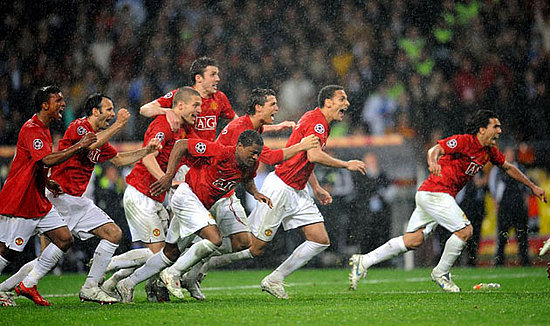
The club regained the Premier League in the 2006–07 and 2007–08 seasons, and completed the European double by beating Chelsea 6–5 on penalties in the 2008 UEFA Champions League Final in Moscow's Luzhniki Stadium. Ryan Giggs made a record 759th appearance for the club in this game, overtaking previous record holder Bobby Charlton. In December 2008, the club won the 2008 FIFA Club World Cup and followed this with the 2008–09 Football League Cup, and its third successive Premier League title. That summer, Cristiano Ronaldo was sold to Real Madrid for a world record £80 million. In 2010, Manchester United defeated Aston Villa 2–1 at Wembley to retain the League Cup, its first successful defence of a knockout cup competition.

The club crest is derived from the Manchester City Council coat of arms, although all that remains of it on the current crest is the ship in full sail. The devil stems from the club's nickname "The Red Devils"; it was included on club programmes and scarves in the 1960s, and incorporated into the club crest in 1970, although the crest was not included on the chest of the shirt until 1971 (unless the team was playing in a Cup Final). A photograph of the Newton Heath team, taken in 1892, is believed to show the players wearing a red-and-white quartered jerseys and blue shorts. Between 1894–96, the players wore distinctive green and gold jerseys which were replaced in 1896 by white shirts, which were worn with blue shorts. After its name change in 1902, the club colours were changed to red shirts, white shorts, and black socks, which has become the standard Manchester United home kit.

Very few changes were made to the kit until 1922 when the club adopted white shirts bearing a deep red "V" around the neck, similar to the shirt worn in the 1909 FA Cup Final. They would remain part of their home kits until 1927. In 1934, players sported cherry and white hooped shirts, but the following season the red shirt was recalled after the club's lowest ever league placing of 20th in the Second Division. The black socks were changed to white from 1959 to 1965, where they were replaced with red socks up until 1971, when the club reverted to black. The current home kit is a red shirt with a white collar, worn with white shorts and black socks. The Manchester United away strip has more often than not been a white shirt, black shorts and white socks, but there have been several exceptions.

These include the navy blue shirt with silver horizontal pinstripes worn during the 1999–2000 season, and the current away kit which is a white shirt with red and black flashes on the sleeves, with black shorts and white socks. An all-grey away kit worn during the 1995–96 season was dropped after just two games because players claimed to have trouble finding their team-mates against the crowd. In 2001, to celebrate 100 years as "Manchester United", a reversible white/gold away kit was released, although the actual match day shirts were not reversible.

The club's third kit is often all-blue, this was most recently the case during the 2008–09 season, to celebrate 40 years since it was worn for the club's first European Cup win in 1968. Exceptions include blue-and-white striped shirts worn during the 1994–96 season, an all black kit worn during the Treble winning season, and white shirts with black-and-red horizontal pinstripes worn between 2003–05. The club's 2008–09 season away kit – a white shirt with blue and red trim, worn with blue shorts and white socks – was used as the club's third kit during the 2009–10 season.

Manchester United FC LOGO

Manchester United FC

Manchester United FC

Manchester United FC

Manchester United FC

Manchester United FC

Manchester United FC

Manchester United FC Champions

Manchester United FC Team

Manchester United FC Shirts

Manchester United Football Club

Manchester United Football Club

Manchester United Football Club

Manchester United Football Club

Manchester United Football Club

Manchester United Football Club


